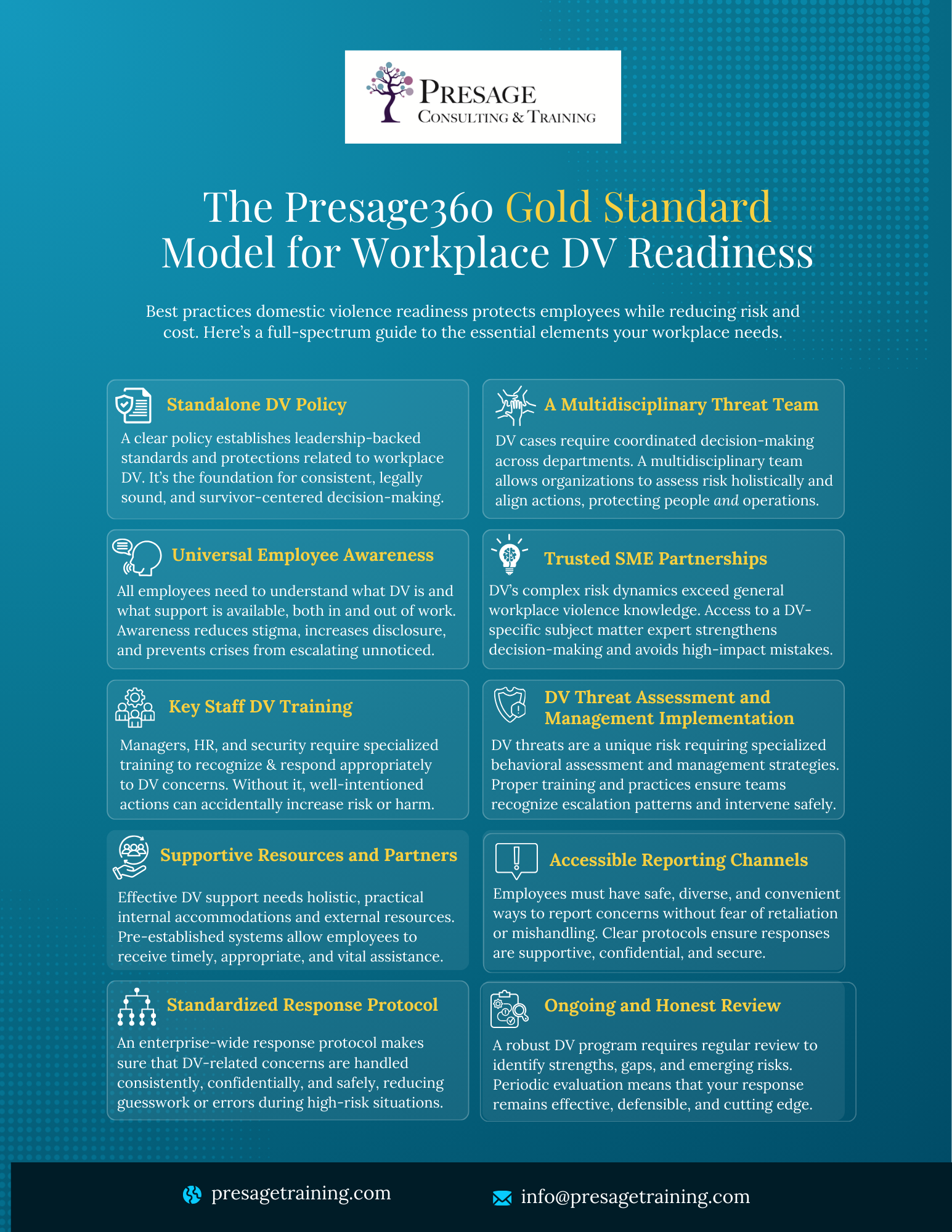
The Presage360 Gold Standard Model for Workplace DV Readiness
Lynn Fairweather, MSW – Presage Consulting and Training, LLC
There is no such thing as a “perfect” workplace domestic violence program.
Organizations vary in size, structure, culture, and resources. Some are just beginning to acknowledge the issue, while others have already implemented policies, trainings, and response protocols. Most fall somewhere in between. But while perfection may be unrealistic, preparedness is not. Over the years, working with organizations across industries, I’ve found that the most effective programs tend to share a common set of elements. Together, these form what I call “The Presage360 Gold Standard Model”, a practical framework for building comprehensive, defensible, and effective workplace domestic violence readiness. Let’s break down these components:
Start with a Standalone Policy
A strong program begins with a clear, standalone domestic violence policy. This isn’t something that should be buried within a broader workplace violence or HR policy. Domestic violence introduces unique dynamics like privacy concerns, safety planning needs, and legal considerations, that require specific guidance. A solid policy acts as the backbone of a robust program and should ideally include the following sections:
· A firm company stance against DV
· Confidentiality protocols
· Specific reporting and response procedures (for impacted employees and concerned coworkers)
· People and locations covered by the policy (including remote work, events, and vendors)
· Prohibitions against discrimination and retaliation toward victims
· Broad definitions of DV that include abuse in dating and LGBTQ+ relationships
· Statements on mandatory staff education and training
· Pledges of support and accommodations for impacted employees
· Pledges of investigation and discipline for violations of policy (as well as intervention programs for abusers)
· Guidance on disclosure of protection orders
· Overview of applicable benefits and resources (internal and community-based)
When we create policies for clients, we focus on ensuring they are leadership-backed, legally sound, and survivor-centered, while also giving managers and HR professionals clear direction on how to respond. Without that foundation, even well-intentioned responses can become inconsistent or risky.
Build a Multidisciplinary Threat Team
Domestic violence cases don’t fit neatly into one department. They may involve HR, security, legal, EAP providers, and often external partners. That’s why a multidisciplinary threat assessment approach is critical. In our work with clients, we emphasize coordinated decision-making, bringing the right people to the table so risk can be assessed holistically, and responses are aligned. This reduces blind spots, encourages consistent case handling procedures, and helps organizations avoid fragmented or contradictory actions. Multidisciplinary teams also prevent “silo-ing”, in which vital knowledge is held within individual departments, but no one is connecting the dots.
An effective multi-disciplinary team combines representatives from various stakeholder departments and leadership, who meet regularly, sharing a common language, knowledge, and structure for assessing and managing threats. Organizations can form a triage system with escalation thresholds for cases that should be presented to the team. Over time, the intervention system can be evaluated and improved based on case outcomes and feedback from involved parties.
Cultivate Universal Awareness
Employees can’t report or respond to something they don’t understand. Workplace awareness is often underestimated, but it plays a key role in prevention. When employees understand what domestic violence can look like and know what support is available, they are more likely to come forward early, providing organizations with crucial opportunities to enhance safety and performance.
A company-wide employee awareness campaign can be tailored to organizational size, scope, and demographics including tools such as breakroom posters, volunteer activities, educational webinars, social media posts, online training modules, paycheck inserts, or merchandise featuring hotline numbers. When we design creative awareness initiatives, we focus on reducing stigma, increasing recognition of warning signs, and making support and reporting pathways visible. While often inexpensive to promote, awareness is frequently what prevents situations from escalating unnoticed.
Train the Right People, the Right Way
Not everyone needs the same level of training, but the right people need the right depth.
Managers, HR, and security professionals are often the first to receive disclosures or observe concerning behavior. Without proper training, even well-meaning responses can unintentionally increase risk.
In our training programs, we focus on helping essential staff recognize domestic violence dynamics, respond appropriately, and avoid common pitfalls that can escalate situations. Key personnel must understand common identifiers of risk, recommended messaging, and proper referral practices, to ensure that the organization’s response is aligned and consistent. A well-trained front-line increases disclosure, improves case outcomes, and reduces errors and legal liability.
Leverage Subject Matter Expertise
Domestic violence is a “different animal” from general workplace violence. It involves patterns of coercive control, emotional dynamics, and risk factors that require specialized understanding. Organizations that rely solely on general security or HR frameworks often miss critical nuances, or worse, respond in a way that exacerbates the situation and makes violence more likely.
That’s why we often encourage organizations to build trusted partnerships with domestic violence subject matter experts (SMEs), ensuring that high-risk or complex cases are informed by the right expertise. While qualified SMEs must possess in-depth DV knowledge and experience, they must also understand the theories and techniques of threat assessment and management, in order to properly evaluate risk in the context of the workplace, and recommend safe, effective interventions.
Implement Threat Assessment and Management Practices
Domestic violence risk is not static, it evolves and can escalate rapidly, expanding risk far beyond the primary victim. Studies show that roughly 1/3 of all workplace violence is domestic violence and 20% of people killed in intimate partner homicides are “corollary victims”, or third parties to the victim-abuser dyad, including coworkers. Therefore, a one-time response is rarely enough. Organizations need the ability to assess risk dynamically and adjust their response as situations change.
In our work, we help organizations implement structured approaches to domestic violence threat assessment and management, including identifying risk factors and escalation patterns, and determining appropriate responses over time. We encourage teams to engage in holistic assessments, combining interviewing, open-source intelligence, situational evaluations, and structured professional judgement tools to develop a comprehensive, “big-picture” case analysis. Then, we work with stakeholders to build a flexible, tailored intervention plan, using decision-point theory and other core concepts of threat management to maximize safety and employee performance. This is where many organizations move from reactive to proactive, offering them priceless preparation time before a tragedy strikes.
Provide Supportive Resources
Supporting employees experiencing domestic violence requires more than good intentions.
It requires practical, accessible resources, both internally and externally. Within a company, this could be a range of remedies that includes options like flexible work arrangements, parking lot escorts from security, or connections to an employee assistance program. Outside of the organization, it could include referrals to community-based services such as safety planning with an advocate, undisclosed shelter, counseling, or legal aid. Support may also come in the form of criminal justice resources such as informing an employee how to file a police report or where to apply for a protection order. It is important to note that while these options may be suggested, they should never be mandated, as any help-seeking action in a domestic violence situation can increase risk, especially if it is implemented without an accompanying safety plan.
Developing existing relationships with local law enforcement and social services in advance of the need can help eliminate delays and uncertainty when referring employees to services. In addition, clearly posting resources for self-access and allowing employees work time to contact assistance can greatly increase a victim’s level of comfort when seeking help. When we work with organizations, we help them to pre-establish resource databases and accommodation menus that ensure employees can access support quickly, confidentially, and without unnecessary barriers.
Ensure Safe and Accessible Reporting
Employees must have a safe way to come forward. If reporting feels risky, unclear, or unsupported, many employees will choose not to disclose, leaving organizations “flying blind”, and unaware of potential safety concerns. Employers must create clear, confidential, and psychologically safe reporting pathways, so employees feel comfortable raising issues before situations escalate.
These should include multiple channels for relaying concerns about self or others such as in-person, by phone, by email, and by text, both identified and anonymously. Resources should also include reporting choices outside of work, such as a local police department or domestic violence hotline. In addition, options should be provided for TTY users or employees speaking languages other than English.
Standardize the Response
Consistency matters. Without a standardized response protocol, organizations risk uneven handling of cases, something that can lead to both safety and liability issues. When we help organizations build response protocols, we focus on ensuring that domestic violence concerns are handled consistently, confidentially, and with a focus on both safety and dignity.
Every employee at every level should know what to do if they see or hear something concerning that could impact the workplace. Most people don’t instinctively know how to respond to a domestic violence disclosure, how to evaluate DV risk, or when to escalate a threat. Protocols need to include clear flowcharts, questions, and thresholds for alerting management, calling 911, or sending a case to the threat assessment team.
Don’t allow untrained human interpretations, opinions, or errors to define your organization’s response to this complex, dangerous issue. Get ahead of the curve by developing and implementing a straightforward, accessible response protocol that works for every case.
Commit to Ongoing Review
Even strong programs can become outdated. Domestic violence dynamics evolve, organizational structures and personnel change, and new risks emerge. That’s why ongoing evaluation is essential. We encourage organizations to regularly assess their programs to identify strengths, gaps, and opportunities for improvement, ensuring their approach remains effective over time. One of the best ways to do this is to survey employees who have disclosed abuse and been offered support by the organization. Find out if they were satisfied with the response to their case and if there’s anything that could have been done better. Evaluation isn’t about pointing fingers; it’s about learning from our mistakes and improving our processes.
Another way to measure progress is to gather data on metrics like absenteeism and health care utilization before implementing a domestic violence program and again one to two years after, so you can see how supporting DV victims improves the company’s bottom line and justifies your investment.
Moving Toward the Gold Standard
Most organizations will not have all these elements fully in place, and that’s okay. The goal is not perfection. The goal is progress.
Each step toward a more structured, informed, and coordinated approach reduces risk and increases the organization’s ability to respond effectively when it matters most. The Presage360 Gold Standard Model is not a checklist to complete overnight. It is a framework to guide organizations toward a more comprehensive and realistic approach to workplace domestic violence readiness. Because when it comes to preventing workplace violence linked to domestic abuse, the difference is often not whether warning signs exist, but whether an organization is prepared to recognize and respond to them.
For organizations seeking guidance on addressing domestic violence risks in the workplace, Presage Consulting and Training, LLC provides specialized, expert training and consulting for security, HR, and threat assessment teams. Learn more at www.presagetraining.com.