The Presage360 SPILL Model: A Threat Assessment Framework for Predicting Domestic Violence Spillover into the Workplace
Lynn Fairweather, MSW – Presage Consulting and Training, LLC
Most workplace attacks linked to domestic violence don’t begin at the workplace. They begin weeks or months earlier with small warning signs; phone calls, unexpected visits, or threats that signal an abusive partner may be preparing to confront the victim where they work.
Intimate partner violence “spillover” is the driver behind nearly 1/3 of all workplace violence, making it a serious risk to everyone on premises. Abusive partners frequently call, stalk, harass, threaten, or physically confront victims at work because the workplace is one of the few locations where their target’s presence is known and predictable. Yet organizations often struggle with a critical question:
Which cases represent routine harassment, and which represent an emerging threat to workplace safety?
Most security teams, HR professionals, and threat assessment groups recognize that domestic violence can affect employee safety. But determining whether a particular situation represents a credible risk to the workplace itself requires a structured way of evaluating warning signs.
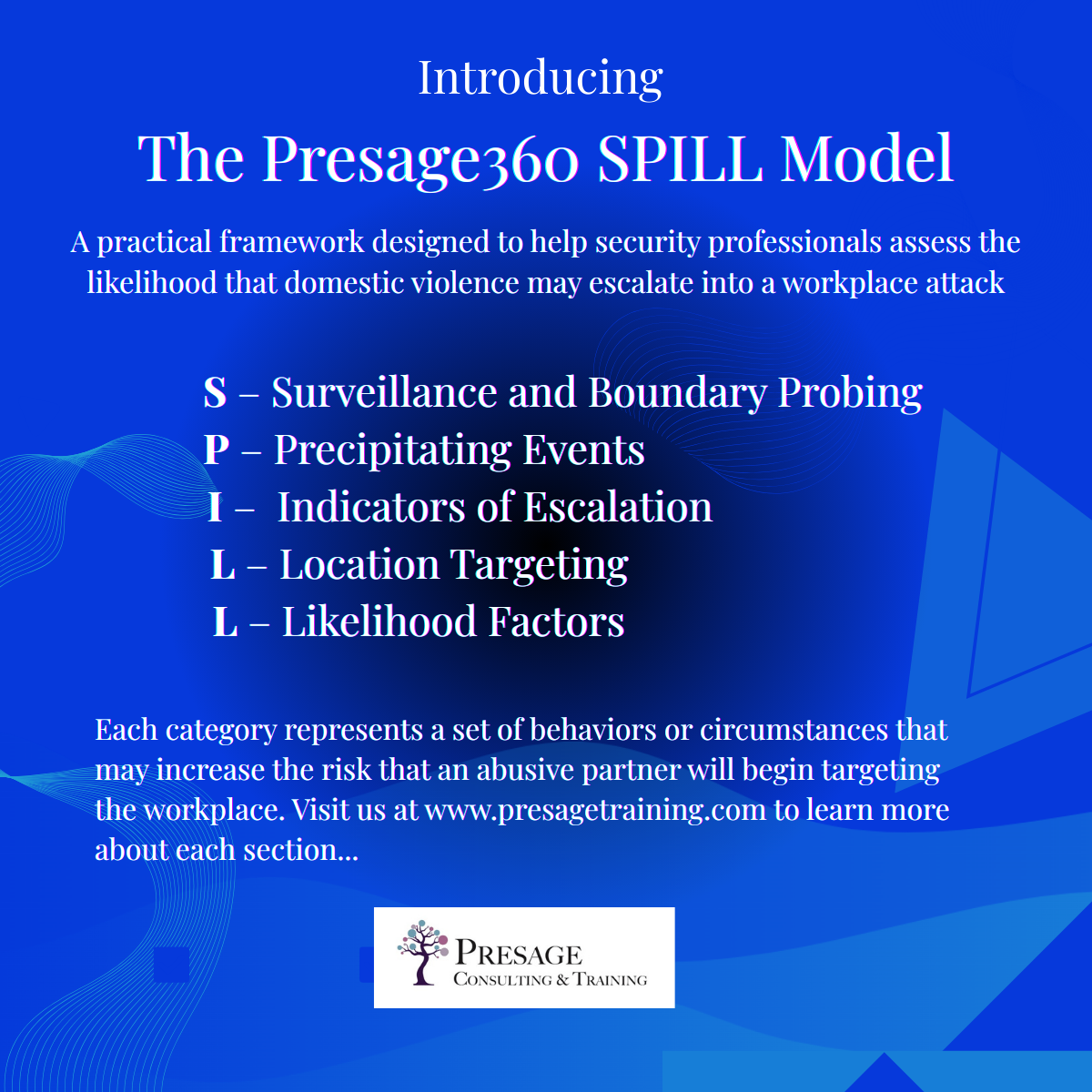
To help address this challenge, I developed The Presage360 SPILL Model, a practical framework designed to help threat assessment teams assess the likelihood that intimate partner violence may escalate into a workplace attack. The SPILL Model highlights five categories of indicators that frequently appear before domestic violence incidents spill over into workplaces.
The Presage360 SPILL Model
SPILL stands for:
S – Surveillance and Boundary Probing
P – Precipitating Events
I – Indicators of Escalation
L – Location Targeting
L – Likelihood Factors
Each category represents a set of behaviors or circumstances that may increase the risk that an abusive partner will begin targeting the workplace. While no single factor predicts violence on its own, the presence of multiple indicators (or “constellations”) should prompt organizations to consider protective measures and threat management strategies. Let’s break down each section:
S: Surveillance and Boundary Probing
One of the earliest warning signs that an abusive partner may begin targeting a workplace is boundary probing. Before violence occurs, perpetrators often test the limits of accessibility to a victim and their points of highest vulnerability. This may include gathering information about the victim’s workplace, schedule, or security procedures.
Examples include:
• Repeated phone calls or messages to the workplace
• Appearing at the workplace unexpectedly (particularly if the visit included aggression,
threats, or assault)
• Asking coworkers about the victim’s schedule
• Attempting to enter the building under false pretenses or sending proxies in their place
• Monitoring entrances, parking areas, or arrival times
These behaviors serve three purposes for the perpetrator: they help gather information on surveillance and ease of access, they measure the strength of your security response, and the test the reaction of the victim and their coworkers. When workplaces ignore these early warning signs, the perpetrator may become emboldened, and more confident in their ability to access the victim.
P: Precipitating Events
Domestic violence risk is rarely static. It tends to spike during moments of crisis or transition in the relationship. These events, known as precipitating or “trigger” events, can significantly increase the likelihood of escalation.
Common high-risk moments include:
• Separation or divorce
• Filing or serving of protection orders
• Child custody disputes
• Criminal charges or police involvement
• Financial stress or job loss
• The victim entering a new relationship (or the subject’s perception of such)
During these periods, perpetrators may feel a loss of control and become increasingly desperate to reassert dominance over the victim. Because victims often rely heavily on their workplaces for stability during these times, the workplace can become a convenient or symbolic location for confrontation. Of particular concern, are situations in which the victim has either entered into an intimate partner relationship with a coworker or the subject erroneously believes they have.
Regardless of whether a new relationship exists, the subject’s perception of such can create “corollary” targets in addition to the primary victim, as they may now seek to harm the perceived “new partner” employee as well.
I: Indicators of Escalation
Escalation behaviors provide important clues that a situation may be becoming more dangerous. These indicators often represent a shift from controlling or manipulative behavior toward intimidation or violence.
Examples include:
• Stalking behaviors and/or destruction of onsite property (i.e., slashing tires in the parking lot)
• Emergence of or increased frequency, hostility, and specificity of threats
• Increase in unwanted contacts and approach proximity
• A departure from baseline in the subject (these can include an “uptick” of frenetic activity, a “downward slide” of self-neglect & dysfunction, or a “calm before the storm” of sudden silence)
• Emergence of or increased severity/intensity in physical violence toward the victim or others
• Preparation activities such as weapons acquisition and practice
Escalation patterns are particularly concerning as they become more frequent, more aggressive, or more public. For threat assessment teams, these changes signal that the perpetrator may have reached a point of decision or desperation and could be moving toward a crisis point where action may be imminent.
L: Location Targeting
A key question in workplace threat assessment is whether the perpetrator is specifically targeting the workplace as the location for confrontation. In many domestic violence cases, the workplace becomes attractive to offenders because it is one of the few places where they know their victim will be at a predictable time, particularly if the victim has fled to a DV shelter or moved to a new undisclosed residence to escape the abuse. In addition, the public access of many workplaces such as a supermarket could be seen as a “soft target”, with fewer security resources than an office building, for example.
Indicators that the workplace may be becoming the focal point include:
• Threatening to come or coming to/near the workplace
• Attempts to locate the victim during work hours
• Attempts to communicate with other employees or enlist proxies (particularly if subject is/was former employee of same organization)
• Hostility toward the employer or coworkers (particularly if sexual jealousy-based)
• Efforts to learn building layout, access points, or security routines
When offenders begin focusing on the workplace itself, organizations should view the situation as a potential workplace violence threat, not just a personal dispute. If other employees have been threatened, workplace safety plans will need to be made for each affected individual.
L: Likelihood Factors
Finally, threat assessment teams must evaluate factors that increase the overall likelihood of violence.
These may include:
• Access to weapons
• Prior history of violence (particularly if it included domestic violence, strangulation, sexual assault, public violence, use of weapons, or if it occurred at a workplace)
• Threats to harm or kill (particularly those with specifications on time, location, or method)
• Mental health or substance abuse issues (particularly suicidality and delusional psychoses or aggression and paranoia enhancing substances)
• Extreme jealousy, obsessive fixation, or possessiveness over victim (“If I can’t have you, no one will”)
• Expressions of desperation and hopelessness (“end game talk”), or leakage of violent intent
• The victim expressing fear that the perpetrator may harm them (even in the absence of proof)
While none of these factors guarantees that violence will occur, the presence of several risk factors significantly increases concern. When these indicators appear alongside other SPILL factors, organizations should strongly consider implementing proactive intervention strategies.
Using the SPILL Model in Workplace Threat Assessment
The SPILL Model is not intended to replace formal threat assessment methodologies or structured professional judgment tools. Instead, it provides organizations with a guideline to evaluate domestic violence situations through a workplace safety lens.
When multiple SPILL indicators are present, organizations may consider interventions such as:
• Workplace safety planning for the affected employee(s) such as saferoom designation
• Adjustments to schedules or work locations
• Enhanced access control or visitor procedures such as BOLOs
• Coordination with law enforcement or courts (i.e. corporate restraining orders)
• Threat assessment team involvement
• Support services for the victim
Understanding and identifying indicators of risk to the workplace allows security teams to ask the right questions and allows organizations the opportunity to act before violence occurs.
Prevention Requires Organizational Awareness
Domestic violence is often framed as a private matter, but it rarely stays at home. When warning signs begin appearing in the workplace, that is when it becomes a shared safety responsibility. The challenge is not simply recognizing that domestic violence exists, it is recognizing when the dynamics of that violence are beginning to spill outward into other environments.
The Presage360 SPILL Model provides a structured way for threat assessment teams to evaluate that risk. By paying attention to surveillance behaviors, precipitating events, escalation patterns, location targeting, and likelihood factors, organizations can begin identifying warning signs earlier and responding more effectively.
No framework can predict violence with certainty. But when organizations learn to recognize the signals that violence may be approaching the workplace, they gain something critical in prevention:
Time.
And in threat assessment, time is often the most valuable asset we have to prevent tragedy.
For organizations seeking guidance on addressing domestic violence risks in the workplace, Presage Consulting and Training, LLC provides specialized, expert training and consulting for security, HR, and threat assessment teams. Learn more at www.presagetraining.com.